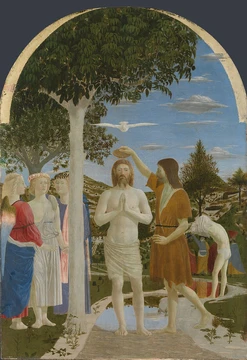
Domenico Ghirlandaio
Florentine painter of fresco cycles with contemporary portraits.

Domenico di Tommaso Curradi di Doffo Bigordi (2 June 1448 – 11 January 1494), professionally known as Domenico Ghirlandaio (also spelt as Ghirlandajo), was an Italian Renaissance painter born in Florence. He was part of the so-called 'third generation' of the Florentine Renaissance, along with Verrocchio, the Pollaiolo brothers and Sandro Botticelli. Ghirlandaio led a large and efficient workshop that included his brothers Davide and Benedetto Ghirlandaio, his brother-in-law Bastiano Mainardi, and later his son Ridolfo Ghirlandaio; many apprentices passed through, including Michelangelo. His particular talent lay in his ability to posit depictions of contemporary life and portraits of contemporary people within the context of religious narratives, bringing him great popularity and many large commissions.
- born
- 2 June 1448
- died
- 11 January 1494
- field
- Painting, fresco, mosaic
- nationality
- Italian (Florentine)
- known_for
- Fresco cycles blending contemporary portraits with religious narratives
Lore & Background
Ghirlandaio was born Domenico di Tommaso di Currado di Doffo Bigordi, eldest of six children. His father and uncle were dealers of silks. According to Giorgio Vasari, Domenico was first apprenticed to his father, a goldsmith, and the nickname 'Il Ghirlandaio' (garland-maker) came from his father's skill in creating metallic garland-like headdresses. He was eventually apprenticed to Alesso Baldovinetti to study painting and mosaic; art historian Günter Passavent states he was apprenticed in Florence to Andrea del Verrocchio. He maintained close association with Botticelli and the Umbrian painter Perugino. An early commission came in the 1470s from the Commune of San Gimignano to decorate the Chapel of Santa Fina (1477–1478). In 1481, Pope Sixtus IV summoned him to Rome to paint frescoes in the Sistine Chapel, including the Vocation of the Apostles and the now-lost Resurrection of Christ. Between 1482 and 1485, he painted a fresco cycle in the Sassetti Chapel of Santa Trinita for banker Francesco Sassetti, with scenes from the life of Saint Francis. The altarpiece of that chapel, an Adoration of the Shepherds (1485), shows his indebtedness to Hugo van der Goes's Portinari Altarpiece. From 1485 to 1490, Ghirlandaio painted the Tornabuoni Chapel frescoes in Santa Maria Novella, depicting the lives of the Virgin Mary and St. John the Baptist, with twenty-one portraits of the Tornabuoni and Tornaquinci families. He also painted altarpieces such as the Virgin Adored by Saints Zenobius, Justus and Others, the Adoration of the Magi, and the Visitation (1491). He painted panel portraits including Giovanna Tornabuoni (1488) and the Portrait of an Old Man and his Grandson. According to Vasari, he painted classical nude scenes for Lorenzo II de' Medici, now lost, and designed mosaics including the Annunciation.
Reader's Guide
Domenico Ghirlandaio was a central figure in the Florentine Renaissance, known for fresco cycles that integrated contemporary Florentine life and portraits into religious narratives. His workshop trained numerous artists, including Michelangelo, and his ability to secure large commissions from powerful patrons like the Sassetti and Tornabuoni families reflects his popularity. His work in the Sistine Chapel placed him among the leading painters of his era. Ghirlandaio's frescoes in Santa Trinita and Santa Maria Novella are key examples of his skill in combining detailed portraiture with sacred stories, influencing later Florentine painting. His adoption of naturalistic elements from Flemish painting, as seen in the Adoration of the Shepherds, marked an advance in Florentine art. Though primarily a fresco painter, his altarpieces and portraits demonstrate his versatility. His legacy endures through these surviving works, which provide a vivid record of late 15th-century Florentine society and religious life.
Did You Know?
- Ghirlandaio's nickname 'Il Ghirlandaio' (garland-maker) came from his father, who was famed for creating metallic garland-like headdresses worn by Florentine women.
- Michelangelo was one of the many apprentices who passed through Ghirlandaio's workshop.
- In the Sassetti Chapel frescoes, Ghirlandaio included portraits of Lorenzo de' Medici, banker Francesco Sassetti, and Lorenzo's children with their tutor Agnolo Poliziano.
- The Tornabuoni Chapel frescoes contain no fewer than twenty-one portraits of the Tornabuoni and Tornaquinci families.
- Ghirlandaio's altarpiece for Giovanni Tornabuoni, the Virgin with the Two Marys, is the only time the two Marys are seen without Mary Magdalen, because Mary Magdalene was never pregnant and thus not a fitting subject for that commission.
The Workshop as a Creative Engine
Ghirlandaio ran one of the most productive painting workshops in late-fifteenth-century Florence. The operation was essentially a family enterprise: his brothers Davide and Benedetto worked alongside him, and his brother-in-law Bastiano Mainardi, a painter from San Gimignano, contributed as well. In the later years, his own son Ridolfo joined the team. Beyond this core circle, a steady stream of young apprentices rotated through the studio, and among them was the teenage Michelangelo. This structure allowed Ghirlandaio to take on multiple large-scale commissions simultaneously, from church chapels to civic buildings. His particular strength—embedding recognizable portraits of living patrons and contemporaries inside sacred narratives—made him enormously popular with wealthy clients. Bankers, church authorities, and civic bodies all sought his hand, and the sheer volume of work flowing through his workshop testifies to how central he was to Florentine decorative painting in the 1480s.
Painting the Present into the Sacred
Ghirlandaio's defining artistic contribution was his instinct for weaving the visible world of his day into scenes drawn from scripture and hagiography. Rather than treating religious subjects as timeless abstractions, he populated them with the faces of Lorenzo de' Medici, his children, their tutor Agnolo Poliziano, the banker Francesco Sassetti, and even his own self-portrait. In the Sassetti Chapel cycle at Santa Trinita, a fresco of Saint Francis resuscitating a child includes the painter's likeness among the onlookers, and the Adoration of the Shepherds altarpiece presents shepherds rendered with a naturalism that represented a genuine step forward in Florentine painting. This approach was sharpened by his encounter with Hugo van der Goes's Portinari Altarpiece in 1483, whose oil-painted textures and lifelike rural figures left a deep impression. Ghirlandaio absorbed that naturalism and translated it into fresco, giving his sacred scenes a grounded, immediate quality that set his work apart from more idealized contemporaries.
From San Gimignano to the Sistine Walls
Ghirlandaio's career spanned a remarkable geographic and institutional range. His early breakthrough came in the late 1470s when the Commune of San Gimignano commissioned him to paint two miraculous episodes connected to the death of Saint Fina in the city's Collegiate Church. By 1481, Pope Sixtus IV had summoned him to Rome as part of a team of Florentine and Umbrian artists decorating the walls of the Sistine Chapel; there he executed the Vocation of the Apostles and a now-lost Resurrection of Christ. Back in Florence, he painted a life-sized Last Supper and a companion St. Jerome in His Study at Ognissanti, and from 1481 to 1485 he produced frescoes in the Palazzo Vecchio, including the over-life-sized Apotheosis of St. Zenobius in the Sala del Giglio, praised for its elaborate architectural setting and masterful sense of depth. An agent of Ludovico il Moro, writing in 1484, described him as a good panel painter but even better in mural fresco, active and very creative—a contemporary assessment that captures the breadth of his output.
Family Ties and the Third Generation
Ghirlandaio was born Domenico di Tommaso Curradi di Doffo Bigordi in Florence on 2 June 1448, the eldest of six children of Tommaso Bigordi and his first wife Antonia. His father and uncle were both silk dealers, and Vasari recorded that young Domenico first apprenticed to his father, a goldsmith celebrated for crafting the metallic garland-like headdresses worn by Florentine women—hence the nickname 'Il Ghirlandaio.' Only Domenico and his brothers Davide and Benedetto survived childhood. His half-sister Alessandra, born in 1475 to his father's second wife, married the painter Bastiano Mainardi in 1494. Ghirlandaio is grouped with Verrocchio, the Pollaiolo brothers, and Botticelli as part of the so-called 'third generation' of the Florentine Renaissance. He maintained close professional ties with Botticelli and with the Umbrian painter Perugino, and his workshop became a hub through which artistic knowledge and technique passed to a new generation, including Michelangelo, before his death on 11 January 1494.
Frequently Asked Questions
Who is Domenico Ghirlandaio?
He was a Florentine painter born on 2 June 1448 whose birth name was Domenico di Tommaso Curradi di Doffo Bigordi. The nickname Ghirlandaio (sometimes written Ghirlandajo) came from his father's trade of crafting decorative wreaths.
What is Domenico Ghirlandaio most famous for?
He is best known for large fresco cycles that interwove recognizable portraits of living Florentines into biblical and hagiographic scenes. This blend of contemporary portraiture with religious narrative became his defining artistic signature.
Who worked in Ghirlandaio's workshop?
He ran a large, productive studio staffed by his brothers Davide and Benedetto, his brother-in-law Bastiano Mainardi, and later his own son Ridolfo. The workshop also trained many young artists, the most notable being the teenage Michelangelo.
Where does Ghirlandaio fit in the timeline of Florentine Renaissance painting?
He is grouped with Verrocchio, the Pollaiolo brothers, and Botticelli as part of what is called the 'third generation' of Florentine Renaissance painters. This placed him between the early Renaissance pioneers and the High Renaissance masters who came after.
When did Domenico Ghirlandaio die and what happened to his workshop?
He died in Florence on 11 January 1494, at the age of forty-five. His family members and trained assistants carried on the workshop's operations after his passing.
More in Renaissance Artists 1-17
Spotted an error? Know more?
This is a living reference — every entry is fact-audited, and reader corrections feed straight into our audit queue. Suggest an edit · See this site's audit record