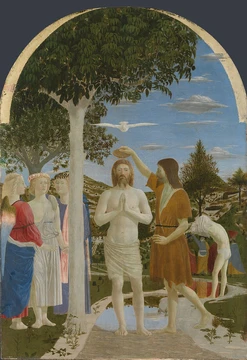
Giovanni Bellini
Venetian painter who revolutionised colour and influenced Giorgione and Titian.

Giovanni Bellini (c. 1430 – 29 December 1516) was an Italian Renaissance painter, probably the best known of the Bellini family of Venetian painters. He was raised in the household of Jacopo Bellini, formerly thought to have been his father, but now that familial generational relationship is questioned. An older brother, Gentile Bellini, was more highly regarded than Giovanni during his lifetime, but the reverse is true today. His brother-in-law was Andrea Mantegna. Giovanni Bellini was considered to have revolutionised Venetian painting, moving it toward a more sensuous and colouristic style. Through the use of clear, slow-drying oil paints, Giovanni created deep, rich tints and detailed shadings. His sumptuous colouring and fluent, atmospheric landscapes had a great effect on the Venetian painting school, especially on his pupils Giorgione and Titian.
- born
- c. 1430, Venice
- died
- 29 December 1516
- field
- Painting
- nationality
- Italian (Venetian)
- known_for
- Revolutionising Venetian painting with oil paints, rich colouring, and atmospher
Lore & Background
Giovanni Bellini was born in Venice. The painter Jacopo Bellini had long been considered Giovanni's father, but art historian Daniel Wallace Maze claims that Jacopo was his much elder half-brother, and that Gentile Bellini was his nephew rather than his brother. He lived and worked closely with his brother Gentile. His early paintings are all executed in the old tempera method. His Dead Christ paintings feature less harshness of contour and a broader treatment of forms and drapery. Giovanni's early work is often linked compositionally and stylistically to the work of Andrea Mantegna, his brother-in-law. In 1470, Giovanni received his first commission to work with Gentile and other artists in the Scuola di San Marco, where he painted a Deluge with Noah's Ark. His Transfiguration, now in the Capodimonte Museum of Naples, was probably painted after 1470, exhibiting greater artistic mastery and a more serene spirit than his early work in Venice. Also likely from this period is the altarpiece of the Coronation of the Virgin at Pesaro. Many of Giovanni's great public works are now lost. His famous altarpiece, painted in tempera for a chapel in the church of S. Giovanni e Paolo, was destroyed along with Titian's Peter Martyr and Tintoretto's Crucifixion in the disastrous fire of 1867. After 1479–1480, much of his time and energy were devoted to his duties as conservator of the paintings in the great hall of the Doge's Palace. He was awarded first the reversion of a broker's place in the Fondaco dei Tedeschi, and afterwards, as a substitute, a fixed annual pension of eighty ducats. He was commissioned to paint a number of new subjects in further illustration of the part played by Venice in the wars of Frederick Barbarossa and the pope. These works were the object of universal admiration while they lasted, but not a trace of them survived the fire of 1577.
Reader's Guide
Giovanni Bellini's significance lies in his transformation of Venetian painting through the adoption of oil paints, which allowed for deep, rich tints and detailed shadings. His work moved from the Quattrocento style to a more sensuous and colouristic approach, influencing the Venetian school and his pupils Giorgione and Titian. After 1479–1480, much of his time was devoted to duties as conservator of paintings in the Doge's Palace, where he painted historical subjects that were lost in the fire of 1577. His religious works, including altarpieces and Madonnas, show his mastery of the oil medium introduced by Antonello da Messina around 1473, achieving perfect fusion of colours and atmospheric gradation. The San Zaccaria altarpiece (1505) is considered perhaps the most beautiful and imposing of his altarpieces. In 1506, Albrecht Dürer, visiting Venice for a second time, described Giovanni Bellini as still the best painter in the city, and as full of all courtesy and generosity toward foreign brethren of the brush. In 1507, Bellini's brother Gentile died, and Giovanni completed the painting of the Preaching of St. Mark which his brother had left unfinished. In 1513, Giovanni's position as sole master in charge of the paintings in the Hall of the Great Council was threatened by his former pupil Titian, who desired a share of the same undertaking. In 1514, Giovanni undertook to paint The Feast of the Gods for the duke Alfonso I of Ferrara. Bellini died on 29 November 1516 and was interred in the Basilica di San Giovanni e Paolo, a traditional burial place of the doges.
Did You Know?
- Art historian Daniel Wallace Maze claims that Jacopo Bellini was Giovanni's much elder half-brother, not his father, and that Gentile Bellini was his nephew rather than his brother.
- Giovanni's famous altarpiece painted in tempera for a chapel in the church of S. Giovanni e Paolo was destroyed along with Titian's Peter Martyr and Tintoretto's Crucifixion in the disastrous fire of 1867.
- After 1479–1480, Giovanni was awarded a fixed annual pension of eighty ducats for his duties as conservator of paintings in the Doge's Palace.
- In 1506, Albrecht Dürer described Giovanni Bellini as still the best painter in the city, and as full of all courtesy and generosity toward foreign brethren of the brush.
- In 1513, Giovanni's former pupil Titian challenged his position as sole master in charge of the paintings in the Hall of the Great Council.
Frequently Asked Questions
Who is Giovanni Bellini?
Giovanni Bellini was a Venetian painter born around 1430, widely regarded as the most prominent member of the Bellini family of artists. He spent his career in Venice and became the defining figure of the city's painting tradition.
What did Giovanni Bellini change in Venetian painting?
He pushed the Venetian school away from its earlier linear traditions and toward a style built on rich oil colour, sensuous light, and atmospheric landscape. This colouristic approach became the foundation for later Venetian masters.
How does Giovanni Bellini's story end?
He died in Venice on 29 December 1516, outliving his older brother Gentile, who had been the more celebrated of the two during their shared years. By the end of his long career, Giovanni's reputation had fully eclipsed his brother's.
Why is Giovanni Bellini important?
His innovations in oil technique, colour, and landscape directly shaped the work of Giorgione and Titian, making him a crucial bridge between the early and high Renaissance in Venice. Without his experiments, the Venetian colour tradition that followed would look very different.
How does Giovanni Bellini compare to his brother Gentile?
While Gentile was the more highly regarded painter during their lifetimes, modern scholarship has reversed that ranking and placed Giovanni at the top of the family's legacy. The two worked in different contexts—Gentile in court service, Giovanni in Venice—but both were products of the same household.
More in Renaissance Artists 1-17
Related in Renaissance Artists
Links follow this subject's own source article.
Spotted an error? Know more?
This is a living reference — every entry is fact-audited, and reader corrections feed straight into our audit queue. Suggest an edit · See this site's audit record